
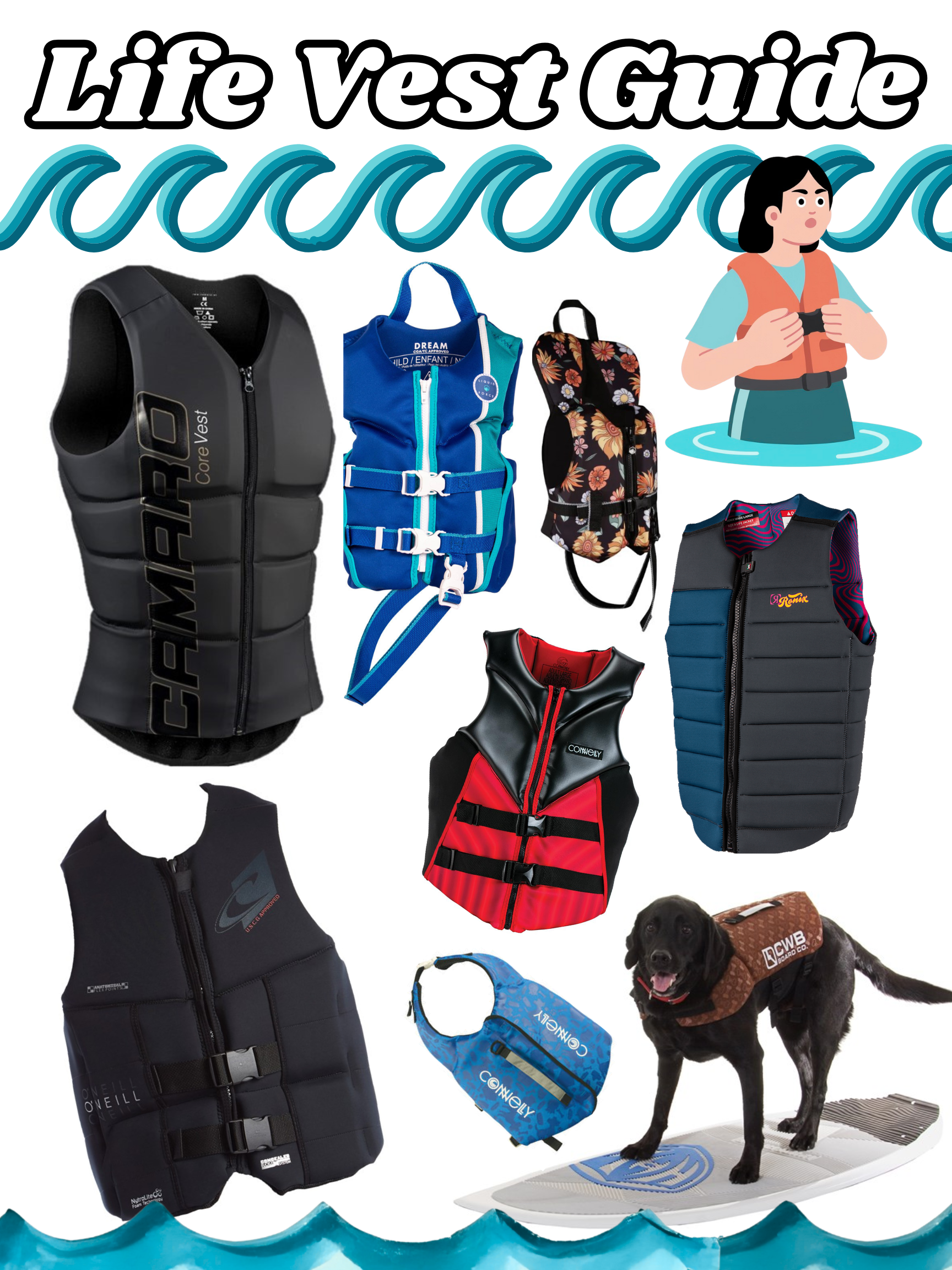
Life Vest Guide
Jan 15th 2026
A general guide to how your life vest should fit and the differences between competition life jackets and CGA life vests.
Life jackets are an essential part of watersports, keeping us safe on the water. Anyone under the age of 13 must wear a life jacket at all times when on the deck of a boat that's underway, according to USCG federal law. Adults are required to wear a vest when operating a personal watercraft or being towed. Pets are not required to wear life jackets, but many owners err on the side of caution. Many animals can tire quickly when swiming and life jackets are especially important if your pet is not an avid swimmer. It is always recommended to wear some sort of PFD when near or on the water, even in situations where it may not be strictly illegal not to.
Sizing
Adult Vests
- Adult vests are sized according to chest size, not weight.
- When measuring chest size, check the circumference around the broadest point of your chest
- Life jackets should fit snugly while still being comfortable.
- Always zip up first, then adjust the straps.
- A good way to check if the vest fits properly is to have someone pull on the shoulder straps, if the straps reach your ears or nose, it may be a sign to size down if it can't be readjusted.
Childrens Vests
- Children's vests are sized based on weight.
- Babies under 18lbs are not advised to be brought on board a boat.
- Kids are only allowed to wear foam PFDs, no inflatable PFDs for the little ones.
- Similarly to checking adult vests, have your child raise their arms over their head and pull up on the shoulders. If the vest hits their ears or chin, readjust the straps or try another size.
- For kids under 50lbs vests should have a grab handle, a flost collar, and a crotch strap.
Animal Vests
- Make sure the vest fits snugly, and your pet cannot wriggle out of the jacket.
- Lift the front of the vest after adjusting the straps. If your pet's body lifts with the jacket, it fits properly.
- Your pet should be able to move normally with no hindrance to any limbs or neck.
- If the jacket moves around when in the water or chafes, it is not the right fit.
- Animals will let you know if the vest is uncomfortable or ill-fitting. If they are constantly trying to get out of their vest, most likely the vest does not fit properly.
- Check the outside of the jacket for a smooth surface, as you do not want anything snagable
- Many pet vests are equipped with a quick-release buckle and have a handle on the top to easily get your pet in and out of the water.
- It's always good to do a water test in shallow water to ensure the jacket is fitting optimally.
Comp Vest V.S. CGA Life Vest
For a life jacket to receive USCG certification, it must pass several tests ("UL 12402-5") through an independent laboratory. The testing standards require that a CGA life jacket include providing at least 15.5 pounds of buoyant force, passing in-water buoyancy tests, having an attached label displaying its certification and buoyancy level, weight range, and certain safety icons, and adhering to certain specifications for materials, fitment, stitching, fastening, and sealing of foam or inflatable chambers. A comp vest is also a Type III device. Like a life jacket, it's designed to provide some buoyancy, but it's not meant to be a life-saving device. It won't protect an unconscious person from drowning. The key difference between a life jacket and a competition vest isn't in their type, but in their safety certification -- or lack thereof.
Comp Vest
- Design: Tailored for performance, these vests offer enhanced flexibility, allowing for a broader range of motion. This makes them a favorite among professional athletes and those performing tricks on the water.
- Buoyancy: Comp vests inherently provide less buoyancy compared to CGA vests. It's important to note that while they expand when submerged in water, this expansion does not compensate for their reduced buoyancy. Always exercise caution when relying on them in water.
- While they prioritize flexibility, they do not meet the strict buoyancy standards of CGA vests.
- You want a tighter fit, as the comp vest will expand in the water.
CGA Life Vest
- Certification: Endorsed by the United States Coast Guard, ensuring they meet rigorous safety standards.
- Adhere to buoyancy levels set by the United States Coast Guard, ensuring wearers remain afloat even in challenging water conditions.
- Design: Prioritizes buoyancy, making them ideal for those new to watersports or engaging in activities where there's a higher risk of falling into the water.
If you have any further questions feel free to call us.
Open Monday - Saturday
9AM - 5PM
206-762-1300