
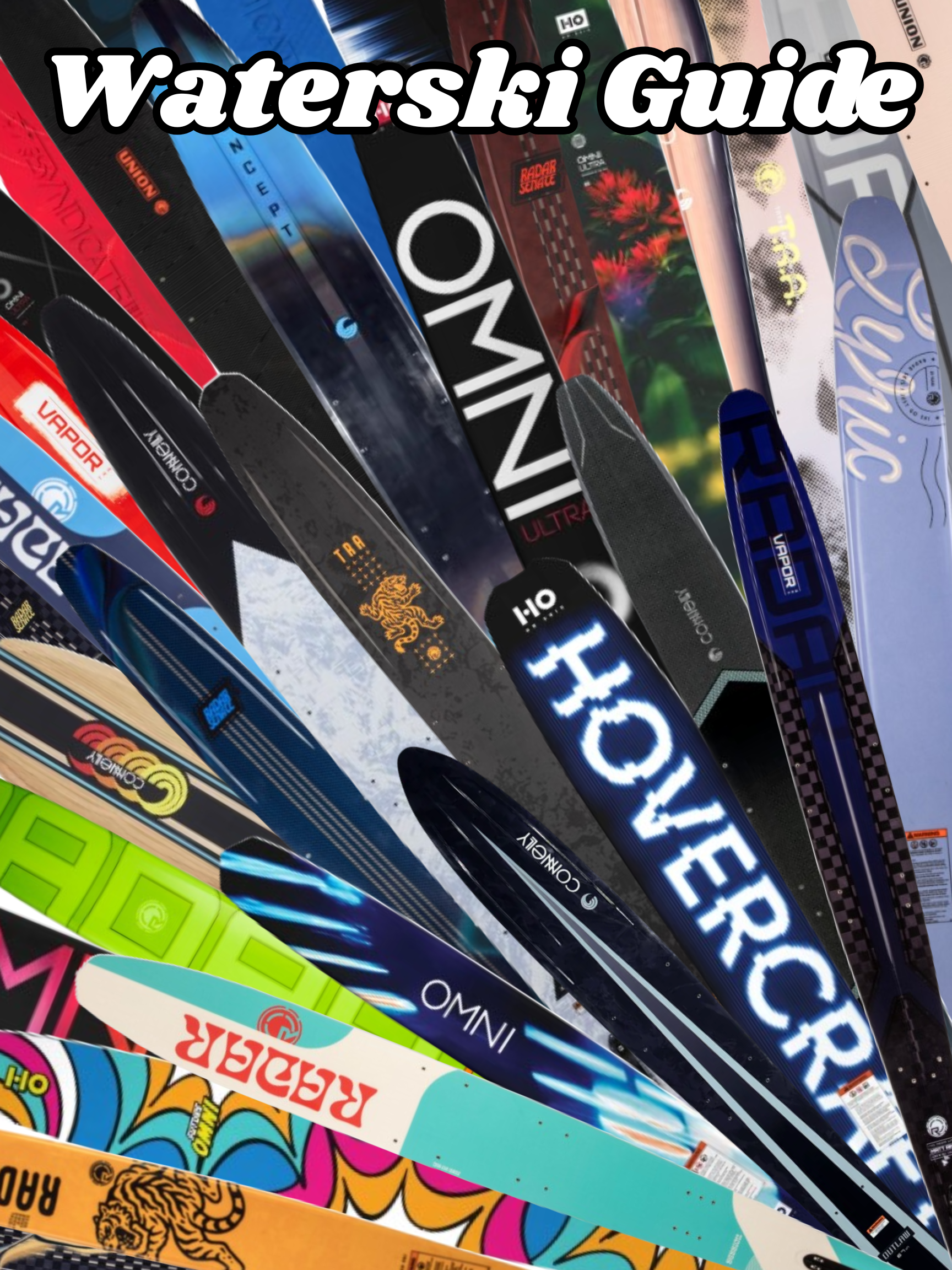
Waterski Guide

Waterski Guide

Feb 10th 2026

A general guide to finding the right ski for you, along with some basic tips and tricks.

Types Of Slalom Skis

Open Water

 These skis are for the  more recreational skier focusing on easy starts, stability, and smooth carving, featuring more surface area, concave bottoms, and grip rails for lift and reduced drag, making them great for learning or cruising.

2026 Options: Radar Session, HO Hovercraft, Connelly Big Daddy, Connelly Big Easy,


Crossover

 If you're looking for an all-around ski that performs well at different speeds the crossover is for you. These skis are versatile hybrids blending high-performance course skiing with easy open-water fun, featuring designs like wider shapes and specialized rocker lines for stability and acceleration, letting skiers enjoy both competitive-style runs and recreational carving. 

2026 Options: HO Omni, Radar Senate, Radar Lyric, Radar Union, Connelly Outlaw '26, Connelly Concept


Course

 A course ski is for the hardcore enthusiast that participates in competitions. These skis are built for speed, balance, and agility to carve across the boat's wake. 

2026 Options: Radar Vapor, Radar Vapor Pro Build, HO Sabre, HO Syndicate Works 01/02, Connelly C1, Connelly Rocket 


Trick Skis

Trick skis are a little different from your average water ski. The ski itself is a short, flat, wide ski with no fins, allowing the rider to rotate freely on the water. They are typically used in tournaments where competitors have a limited amount of time to show off their skills.

SLALOM WATER SKI SIZE CHART

SKIER WEIGHT 

BOAT SPEED

20-30MPH

BOAT SPEED

30-34MPH

BOAT SPEED 

34-36MPH

60-100LBS

59”-63”

59”-63”

59”-63”

95-125LBS

62”-64”

62”-63”

62”-63”

115-140LBS

64”-66”

63”-66”

63”-65”

135-160LBS

66”-67”

65”-66”

64”-65”

150-180LBS

67”-68”

67”-67”

65”-67”

170-200LBS

68”-72”

67”-68”

66”-68”

190-215LBS

72”

68”-72”

67”-68”

210LBS & UP

72”

68”-72”

68”-72”


Kids Slalom

Kids skis are designed for smalled riders and range in skill levels.  


Materials
There are a lot of factors when it comes to choosing a ski, and materials are one of them. Typically, you will see options like alloy, graphite, and lithium. Different material effect skis' overall weight, flex, reactivity, and speed. It is important to have a basic understanding of what makes each of these material different and which material is best for your current skill level.

Alloy: Alloy is going to be the most forgiving material, good in choppy waters, and best for beginners, as it is the most stable. They often have a Polyurethane (PU) core with carbon/glass layers.
Graphite: Graphite skis are going to be stiffer than alloy-based skis. They typically have more carbon in them. This material gives a more balanced fast responding ski for course activites.   Graphite is great for those who are moving up in skill level and is a great mix of performance and value.  They often have a PU core with extra carbon for stiffness.
Lithium: This is going to be the most expensive material, as they are highly responsive, being the lightest and the fastest, but the least forgiving. This material is best for advanced course skiiers, best used on the water with ideal conditions. These skis have the highest-end cores (like PVC or PMI) with a full carbon core.

COMBO SKIS
Combo water skis are a pair of wider, more stable skis, one for each foot, designed for beginners to easily learn how to water ski by providing stability and easier deep-water starts, often allowing for progression to a single slalom ski by dropping one ski when ready.  They feature simple, adjustable bindings, a broader surface area, and sometimes a V-bottom for better tracking, making learning balance and turns simpler before mastering advanced single-ski techniques. Combo water skis are typically shorter and wider than slalom skis. Most adult combo water skis are 65" to 68" long, and most kids' combo water skis are 45" to 47". 

Standard skis: They measure 6" to 7" wide and are considered skinnier than other options. Getting up and moving is more difficult on skis this wide -- but you get better speed and responsiveness.

Medium skis: They measure 7" to 8" wide and provide some extra surface area. This makes getting up and riding easier for beginners, while still being nimble. This width is a "happy medium" that allows new riders to get faster and get more aggressive as their confidence grows.

Wide skis: They measure 8" to 9" and are the easiest to learn on, especially when it comes to getting started in deep water. They provide the most stability, making them ideal for brand-new and large riders. But they do sacrifice some top speed and maneuverability.

Combo Water Ski Size Chart
Weight  Size 
50 - 100 lbs 58" - 60"
80 - 130 lbs 62" - 64"
120 - 160 lbs 65" - 66"
150 - 200 lbs 67" - 68"
180 - 220 lbs 69" - 70"
200+ lbs 71" - 72"


Beginner Tips

  • Start with a combo pair (children may need trainer skis) 
  • Better to start with a longer ski than normal 
  • Starting with double skis will help with getting up and more surface area for easier starts

General Maintenance

  • Store your equipment in a cool, dry place away from direct sunlight to prolong its lifespan  
  • Rinse all equipment with freshwater and immediately dry it thoroughly in a shaded, well-ventilated area
  • Protect fins 
  • Never place a ski bottom-side down on any surface as it can cause damage  to the fins and scratch the base 


Waterski Acessories

Gloves
Waterski gloves can improve your performance in a myriad of ways. Gloves will enhance your grip, keep your hands warm in cold conditions, and minimize potential injuries. Finding the right size is crucial. Most brands fit snug and should be sized up accordingly, especially if you're between two sizes.
Ropes and Handles
Having a good rope and handle is a crucial part of waterskiing.  They come in various types, each designed for a particular purpose. Recreational or standard ropes are used by most riders and mainly come in a rope/handle bundle. Standard ski ropes are 75ft, 70 ft of rope attached to the handles split rope(5ft). They are adjustable in length, typically in 8 or 10 sections, to suit your preference.  Recreational rope is built to be stretchy, reducing shock to the rider's arms. Tournament ropes are typically used by slalom skiers. They are built to have less stretch and are shorter, coming in at 60ft, standard length for slalom ski courses. A good handle will provide comfort and a sturdy grip. Foam handles are great for those without gloves and provide more comfort for recreational skiers. Rubberized handles are for slalom skiers looking for added grip and performance. People who use rubber handles typically wear gloves. Another thing to look at when selecting a handle is how the line attaches to the handle. Handles with a long Y section provide better control, stability, and balance as you ride. The longer Y section makes for easier deep water starts, making them great for beginners.  A shorter Y section reduces handle roll once you’re up and cruising and has better responsiveness and more consistent pulling power.
Beginners: Longer, stretchier ropes with a padded straight handle
Advanced: Specialized ropes, less stretch, medium length
Safety:
  • Never wrap the rope around any body parts.
  • Stay clear of the rope when starting and stopping.
  • Have a spotter to watch the skier and the rope at all times
  • Handle guards are used to prevent your head and limbs from going through the handle opening and getting caught.
  • Replace ropes once they show signs of wear; sudden breakage can cause injuries.  

If you have any further questions about waterskis, please call or email us!
Open Monday — Saturday
9AM - 5PM
Sales@WileySki.com
206-762-1300