
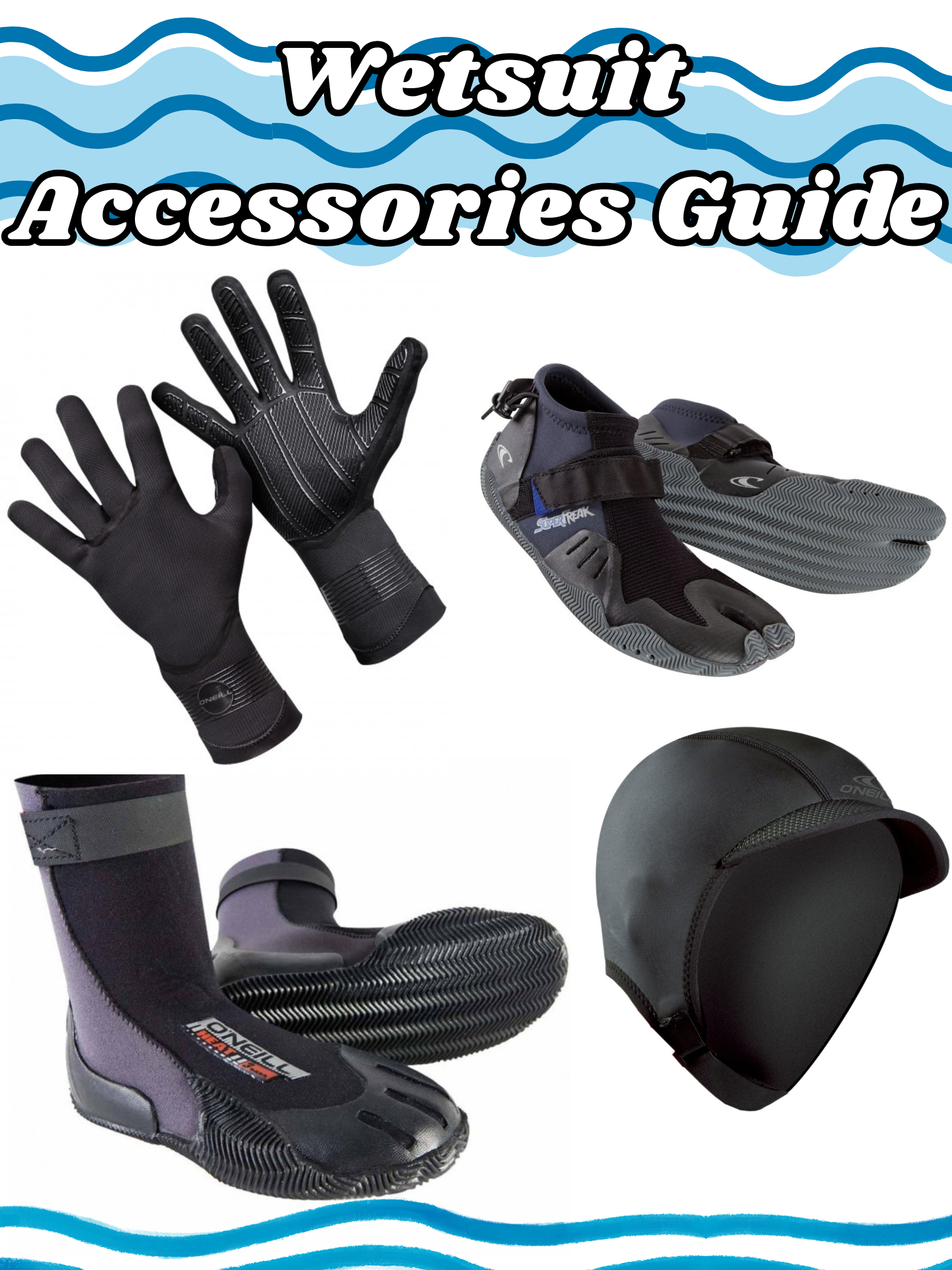
Wetsuit Accessories Guide
Jan 14th 2026
Outer extremities like your head, hands, and feet lose body heat faster than any other parts of the body. The lack of body fat combined with the higher blood flow in these areas increases rapid heat loss. There are several products that can help keep you warm and protected from the elements alongside your wetsuit. To better understand your options, here are a few common accessories
Gloves
Gloves keep your hands nimble in the water and stop your fingers and hands from going numb. They lock in heat, countering water’s ability to pull heat from your body 25 times faster than air. A hand that feels fine in 59°F (15°C) air will ache in seconds in the same temperature water if left bare. Grab a 3 mm glove to slow heat loss by up to 40%; double your protection with a 5 mm glove. Thicker gloves keep you warmer, but they reduce dexterity—so weigh your activity, exposure time, and wind chill during selection. Wear gloves when temperatures drop below 68°F or 20°C.
Global Temperature–Thickness Reference Table
| Temperture | Thickness | Situtation |
| 72–77 °F(22–25 °C) | None or 1 mm | Tropical / reef snorkeling – gloves optional |
| 64–70 °F(18–21 °C) | 2 mm | Light insulation, full dexterity for paddling |
| 57–63 °F(14–17 °C) | 3 mm | Standard spring/fall glove; good mobility |
| 50–56 °F(10–13 °C) | 5 mm | Cold-water standard; reduced finger flexibility |
| 43–48 °F(6–9 °C) | 7 mm | Heavy-duty winter surfing / diving gloves |
| < 41 °F(< 5 °C) | 7 mm + liner or dry gloves | Polar or ice-diving conditions – dry seal required |
Wiley’s Options: O'Neill Psycho Tech 3mm Gloves and O'Neill Psycho Tech 1.5mm Gloves
Boots
Similar to gloves, boots help trap the heat, enhance your grip, and protect you from sharp reefs and rocks. When the water temperature hits between 50-57 °F (10-14°C), it’s usually time to get the booties out. Especially at the lower end of the spectrum. Some people wonder if neoprene boots are waterproof, so let us clarify: surf boots work according to the same principle as a regular wetsuit. A thin layer of water is trapped between the neoprene and your skin. This layer is then heated by your body. This means that neoprene boots aren’t waterproof. On the contrary, your feet are always wet.
Models of Boots
Split Toe (ST)
Split-toe boots are built with a split between the big toe and four other toes. It is a full external split that lets the big toe move freely. Some surfers prefer this option due to the added mobility and grip you can get from the separation. The downside to this style is that it is not as warm, considering the external split in the material.
Hidden Split Toe (HST)
This is a hybrid boot style, giving you the feel of a split toe but the warmth of a round toe. The split toe is internal and does not have a visible gap on the outside. With the separation from the big toe, the boots are comfortable and lock your feet in place, giving the best maneuverability and warmth.
Round Toe (RT)
Round-toe boots are the classic style of surf boots. It is the best boot for people getting into surfing or wanting a warm, comfortable fit. The style fits on like a sock and is exceptionally warm due to there being no separation in the toes. Some people prefer a round toe because a split toe can be uncomfortable if you have abnormally shaped toes.
Temperature Guide
| Thickness | Temperture | Where | Benefits |
| 1mm - 2mm |
70ºF & Above (21ºC & Above) |
Warm Tropical Waters | Best for surfers or snorkelers |
| 3mm |
60ºF - 70ºF (15ºC-21ºC) |
Southern California, East Coast summers | Good balance of warmth and board feel |
| 5mm |
50ºF - 60ºF (10ºC -15ºC) |
Pacific Northwest and East Coast during the Spring and Fall seasons | Most widely used in the industry |
| 6.5mm |
40ºF -50ºF (4ºC-10ºC) |
Alaska, the Great Lakes, or East Coast winters | Built for those friged water temperatures |
| 7mm+ |
40ºF & Below (4ºC & Below) |
Alaska, the Great Lakes, or East Coast winters | Built for some of the coldest conditions surfable, the 7mm+ range is not for the faint of heart |
How to Put on Boots
Booties are not always easy to get on and off. Similar to a wetsuit, putting on brand-new boots requires a bit of extra effort. Be patient when putting the boots on. With time and use in the water, the boot rubber will stretch a bit. Here are some tips and tricks to help you.
- Start with dry feet in a spot where you can sit and stand on one foot comfortably.
- If you can roll up the legs of your wetsuit a little to keep them out of the way.
- Roll back the top of your boot at the ankle cuff. One or two rolls should do.
- Stretch the opening with both hands to make room for your foot. The easiest method is by placing both thumbs on the inside of the back of the boot, pointing your toes downward, and slowly sliding your foot into the bootie.
- If you run into resistence wiggle your toes around and gently pull the material over your foot.
- Check to ensure your heel is fully seated in the heel pocket—this helps prevent excess water from entering.
- Tighten any straps just enough to keep them secure without restricting blood flow.
- When you get both booties on, roll the legs of the wetsuit over to the tops of the booties. The wetsuit should overlap the boots a little to create a seal.
Wiley’s Options: O'NEILL Heat R.T. Boot, O'Neill Superfreak Tropical Boot Round Toe, O'Neill Superfreak Tropical Boot Split Toe
Hoods
The head and neck are very sensitive, especially to cold temperatures. These areas play a large role in influencing your overall comfort and perception of temperature. Hoods help keep your head and ears warm, preventing Surfer's Ear, and increasing overall comfort during your session. Just like gloves, most people have a different preference for what temperature they start wearing a hood. Most start wearing a hood once the water temperature gets below 50°F. Air temperature, weather, and the thickness of your wetsuit can also affect your need for a hood. Choosing which hood thickness is best for you really depends a lot on personal preference. When water temperatures get below 14° C (57° F), you can opt for a 1.5mm or 2mm cap or hood. If temperatures dip below 10° C (50° F), a 3mm hood becomes a necessity for most.
Types of Hoods
To keep your head comfortable when the water is freezing, you can choose from two wetsuit accessories: a wetsuit hood or a wetsuit cap. Overall, a wetsuit hood provides more protection on really cold days, while a cap is easier to put on and off and provides more freedom of movement.
Cap: A wetsuit cap usually covers just the top of your head and ears. A cap is often attached with a chin strap or simply worn on top of your head like a beanie. Because your neck remains free, you maintain a lot of freedom to move in the water. If you are worried about the hassle of putting on a hood, a cap can get you the warmth you want with an easier on-and-off design.
Hood: A hood covers your head, neck, and ears. Most hoods are designed to tuck into the neck of your wetsuit. This option is best for the coldest conditions, where you want to keep your neck warm and increase the amount of heat retained in your suit. Some hoods have a secondary flap that is made to easily tuck into your suit and create an effective seal to prevent flushing. A warm hood will elevate your comfort if you are plagued with brain freezes as you paddle out to the lineup.
Hood: A hood covers your head, neck, and ears. Most hoods are designed to tuck into the neck of your wetsuit. This option is best for the coldest conditions, where you want to keep your neck warm and increase the amount of heat retained in your suit. Some hoods have a secondary flap that is made to easily tuck into your suit and create an effective seal to prevent flushing. A warm hood will elevate your comfort if you are plagued with brain freezes as you paddle out to the lineup.
Wiley’s Options: O'NEILL Neoprene 2mm Sport Cap and O'NEILL Coldwater Neoprene Hood
If you're looking for some thicker options that you may not see on our website, give us a call, and we can help get you some thicker cold water gear.
Open Monday-Saturday
9AM-5PM
206-762-1300