
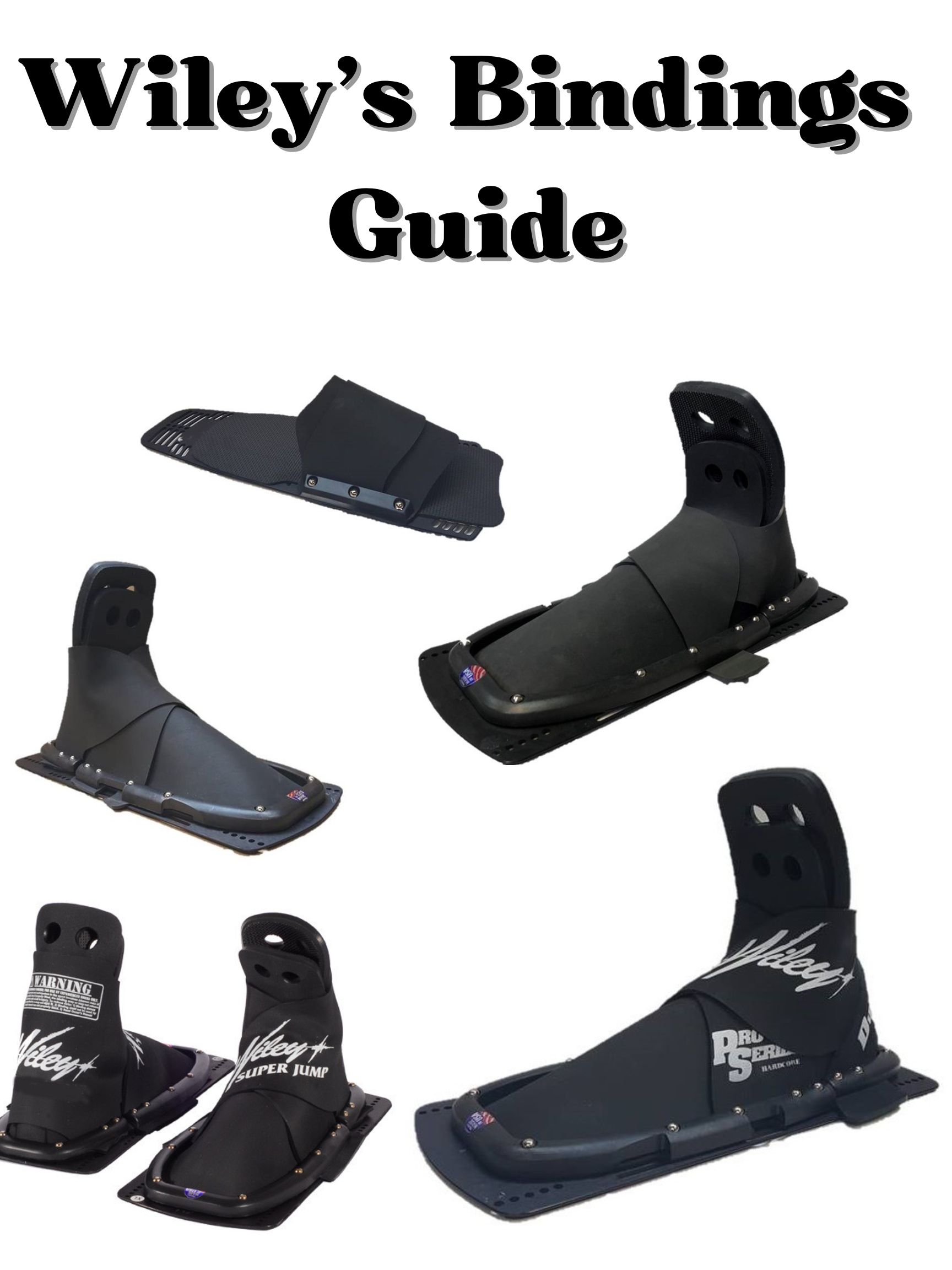
Wiley's Binding Guide
Feb 10th 2026
An overview of our signature bindings. A helpful guide to finding out what binding is best for you.
SLALOM BINDINGS
CBO
Our entry-level, most recreational slalom binding. This binding has a medium-height, one-piece wrap with more stretch to make getting in and out easier. CBO bindings are a best-in-class recreation focused rubber binding. Often, being user friendly and delivering performance are mutually exclusive, but in this case the CBO is the best of both worlds; Easy to get in and out of, and quick to perform. Available in both front and rear options.
Standard Highwrap
The standard highwrap is for recreational skiers who want a highwrap binding that will perform at high speeds, but will be easier to get in and out of compared to its hardcore sibling. The standard highwrap uses the same overlay rubber as the CBO but has two overlays that cross over the forefoot of the binding. Standard Highwrap's are available in both front and rear options.
Hardcore Highwrap
The Hardcore Highwrap our most popular slalom binding. It is worn by many pro skiers including Chris Parrish and Jeff Rodgers, but also works great for recreational skiers looking for a tight fit. This binding is a traditional high wrap boot with the same overlay shape as the Standard Highwrap, just with thicker rubber for a comfortable, glove-like fit. It will have a stiffer feel compared to the CBO and standard highwrap. Hardcore Highwraps come in both front and rear options.
Pro Build Slalom
The Pro Build Slalom is the stiffest, highest-performing binding in the Wiley's Slalom line. The Pro Build overlays use the same rubber as the Hardcore Highwrap, but are slightly wider, which means less stretch. The toe rubber is also the same as the Hardcore Highwrap, but the heel has thicker rubber, for more fore/aft support. On top of this thicker heel rubber is an underlay piece that sits between the heel rubber and the overlays for even more support. The Pro Build is built for skiers looking for ultimate performance in a rubber boot, and it lives up to its name. This binding is available only as a front binding and is often paired with Standard Highwrap rear, CBO rear, or rear toe plate.
Rear Toe Plate
Wiley's keeps it simple with the rear toe plates. Using high performance rubber and overlays, Wiley's rear toe plates are tried and true staples in the waterski world. Wiley's rear toe plates line up nicely with the heel of the slalom bindings, and offer forward and backward adjustability so that skiers can customize their mount to their preference. Wiley's RTP's come feature a footpad that can be stuck to heel of the front boot once it is mounted in the right position. Just peel the white tab by the front of the plate, and press the pad down to the opening between the front of the rear plate and back of the front plate.
JUMP BINDINGS
Standard Jump
These boots are made for beginner and recreational jump skiers. These bad boys are good for 150ft, and are used by ski teams and jumpers around the world. All of our jump bindings use thick rubber heels, and feature a hand-shaped footbed for premium shock absorption on hard landings. Standard Jump bindings are most similar to Hardcore Highwrap slalom bindings with two overlapping overlays. All jump bindings are sold in pairs.
Super Jump
Super Jump bindings are the step up from the Standard Jump. Super Jumps feature a one piece overlay that wraps all the way up to the pull tabs on the heel and toe rubber. This wrap style provides a tighter wrap around the upper ankle for more edge control when coming into the ramp. Good for 120 to 200 feet. Not for the ploppers! The toe rubber, heel rubber, and footbed are the same as standard jumps.
Pro Jump
These are the Jaret Llewellyn and Freddy Krueger inspired boots that will keep you locked into your ski and into your edge on the approach to the ramp. Pro Jumps are not for the faint of heart, they will perform from the water, to the ramp, and then to 200+ feet past the ramp. Before you get in the water, you must first get in the binding, which is a task in itself. On top of the toe/heel rubber that come standard in Wiley's jump bindings, there is a thick one-piece underlay, and two thick crossing overlays on top of that. The "double stuff" design provides the tightest fit, and highest performance, but makes Pro Jumps difficult to get into.
TRICK BINDINGS
Trickwrap
The Wiley's Trickwrap is essentially a Wiley's Super Jump binding, but with gaps in the hardware for universal compatibility with modern trick ski screw inserts. This boot is for the serious trick skier that wants a vice grip on the top of the foot and is looking for a performance fit. The high-wrap one piece overlay holds your foot in place and provides 360° ankle support all while moving allowing flexibility where necessary. This binding is sold as a front binding only.
Rear Toe Plate for Trick
The Wiley's Rear Toe Plate for trick is the partner in crime to the Trickwrap binding. It is a simple rubber toe slip built on a plate that fits the width of modern trick skis. (Please note: the holes on this plate do not always line up with screw inserts on modern trick skis.)
Low Wraps
These bindings are made for quick entry and exits and are typically used by show ski teams that need to swap gear quickly and effeciently. These bindings are not recommended for even the most recreational slalom skier due to the lack of lateral support that they provide. These bindings are sold as front bindings only.

When it comes to choosing to go with a rear toe plate or a double boot, it can be difficult to determine which is best. There is no right answer; they just provide different advantages and disadvantages on the water. The double boot is popular with very advanced and aggressive skiers as it provides more control. The rear toe plate has gained popularity in recent years for providing easier starts to getting out of the water. Experimenting with both setups can help determine which is more comfortable and enhances your performance for your specific style. This list of pros vs cons might help make the decision a little easier.
- Provides extra control and stability, especially in tight turns.
- A stronger connection between both feet and the ski.
- It feels more like wakeboarding; those transitioning from wakeboarding to skiing may like the familiarity.
- Reduces the chances of injuring an ankle or knee when falling by dispersing the energy between both bindings and, thus, both feet and legs.
- It's harder to start with two boots.
- It's not as convenient as a rear toe; lacing up and locking into two boots takes more time.
- For casual skiing and basic carving, the rear toe strap is easier to use.
- Provides greater freedom of movement.
- Rear toe straps are more convenient.
- Skiing with a rear toe strap forces you to work on having better balance atop the ski, which, over time, improves your overall ability.
- Easier deep water starts.
- Rear toe straps provide less control.
- Foot can slip out of position.
- Most have little to no adjustability between sizes.